A wearable breast pump does not always require a pumping bra. A supportive regular bra can work if it keeps the cup centered with gentle, even pressure. At first, the setup may look steady while the wearer is standing still. A few ordinary movements can tell a different story: the housing dips, turns toward the arm, or presses into the cup edge.
That doesn’t automatically mean you need a special bra. Wearable breast pumps remove the hanging bottle and exposed flange that a traditional pumping bra was built to hold. What they add is bulk inside the cup, and the bra has to manage that extra depth and weight without being pulled out of shape.
The practical place to begin is the bra already being worn. If it holds the pump close without crowding the housing or shifting during permitted movement, another purchase may not solve anything. A hands-free pumping bra becomes relevant when those checks keep failing, not simply because the pump is wearable.
What a Pumping Bra Is Built to Do
A traditional electric pump has several pieces that sit outside the bra: flanges, hanging bottles, tubing, and a separate motor. Let go of the flanges and someone still has to keep them in place. That is the problem the openings or overlapping fabric in a pumping bra were made to handle. [Source: U.S. Food and Drug Administration, Types of Breast Pumps]
A nearly empty bottle and a heavier one do not pull in quite the same way. The bra has to absorb some of that change without letting the flange wander. Once it does wander, “hands-free” is no longer doing much work.
This explains the older, fairly firm advice about pumping bras. It was written for hardware that needed an external hold. Move all of that hardware inside the cup and the same advice needs a qualifier.

How Wearable Pumps Change the Job
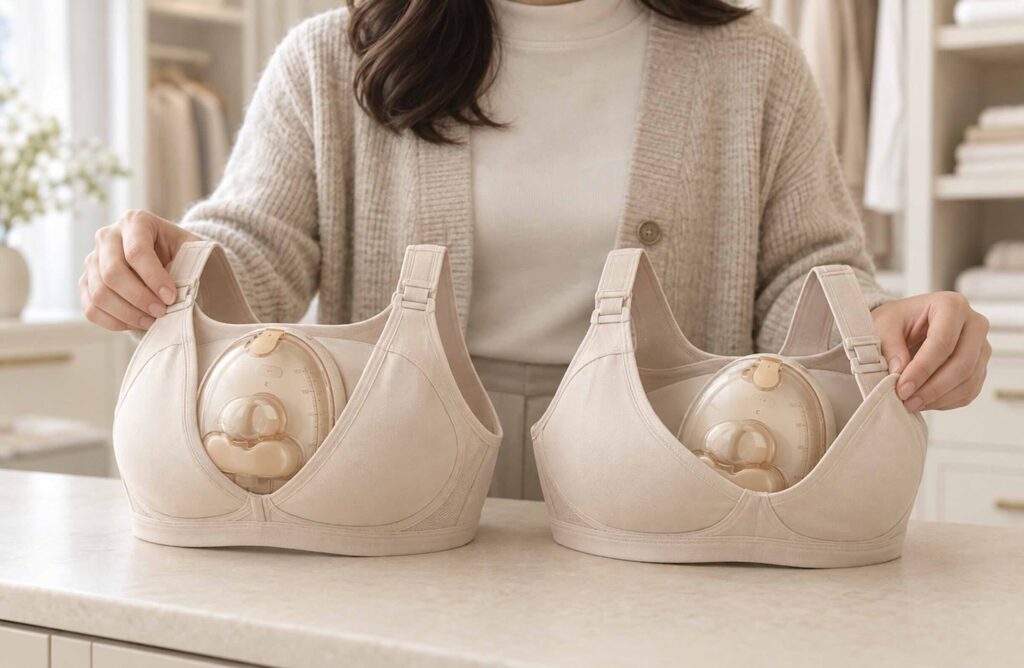
With an all-in-one in-bra pump, the picture changes. The motor and milk container sit together inside the bra, with no bottle below and no tube leading away. Instead of gripping one part of the setup, the fabric has to manage the shape of the whole cup.
What can go wrong? The cup may shift or settle against a seam. Keeping it from doing that is enough. The pump instructions still decide which movements are allowed, since a rule written for one cup shape may not fit another. Many parents can meet those needs with a supportive bra they already wear.
What a Regular Bra Needs to Hold a Pump Cup
A nursing-bra label covers a surprising amount of variation. One bra may have a firm band and fabric that springs back; the next may be a soft lounge style that has relaxed with wear. Put the same pump in both and they can feel unrelated.
Support and Space Have to Work Together
Leave the straps alone for a moment and watch the band. Does it stay level after the pump goes in? If the back climbs while the front drops, shorter straps may hide the pattern for a few minutes, but the band itself is still loose.
Then there is depth. A bra can fit before the pump is inserted and become too shallow immediately afterward. Fabric resting on the housing edge is one clue. So is a loose pocket beside the pump, because that empty space gives the cup somewhere to fall.
The size printed on an older bra may no longer describe today’s fit, and that fit can change again. Use what is happening now. Pain, pronounced marks, or broken skin are reasons to stop and speak with an IBCLC or doctor, rather than tightening the same setup and hoping it settles.
Stretch and Access Shape the Daily Routine
Stretch by itself tells only half the story. Does the fabric return after the pump comes out? If it stays baggy, the housing may wander during the next session. Fabric with almost no give creates the opposite problem and can pin the pump against a seam.
Access is harder to judge until the bra is actually used. A one-handed clip or pull-down cup can be practical, provided the fabric returns to position. If the same narrow edge must be stretched past the pump each time, convenience may come at the expense of fit.
Run through these checks before shopping for a new bra:
| Bra check | A workable sign | A reason to try another bra |
| Band support | Band stays level with the pump inserted | Back rises or the pump sinks |
| Cup space | Fabric covers the pump without gaps or hard pressure | Cup edge cuts in or the pump can tilt |
| Stretch recovery | Fabric returns after the pump is removed | Cup stays stretched or feels rigid |
| Access | Cup opens and closes without a struggle | Hardware or seams catch on the pump |
| Movement | Pump remains centered during normal, permitted movement | Cup slides, rotates, or pulls away |
There is no winning row. Easy clips do not rescue weak support, and a firm band is not much help when the cup edge presses into the housing. Four good signs and one bad one may still mean trying another bra.
Fit Checks Before You Start Pumping
Sitting still is the easy part. Before a session, look at the body, flange, pump cup, and bra together, then try the ordinary movement allowed by the instructions. This is only a fit check, not a replacement for the pump’s guidance.
Check Alignment and Movement
With the pump in place, check three details:
- Centering: The nipple should be centered in the flange tunnel according to the pump maker’s guidance.
- Even support: The housing should sit upright, without leaning into one bra edge or pressing harder on one side.
- Movement: During movement permitted by the instructions, the cup should not rotate, sink, or pull away.
Take a few steps. If the instructions permit bending, try that too. A cup that moves now was not truly stable in the mirror.
Separate Bra Fit From Flange Fit
Bra fit and flange fit can feel like one issue because both meet at the breast. They are not interchangeable. Pressing the pump closer cannot correct the wrong flange size. If sizing is uncertain, or pumping causes discomfort, pause and check with an IBCLC or doctor.
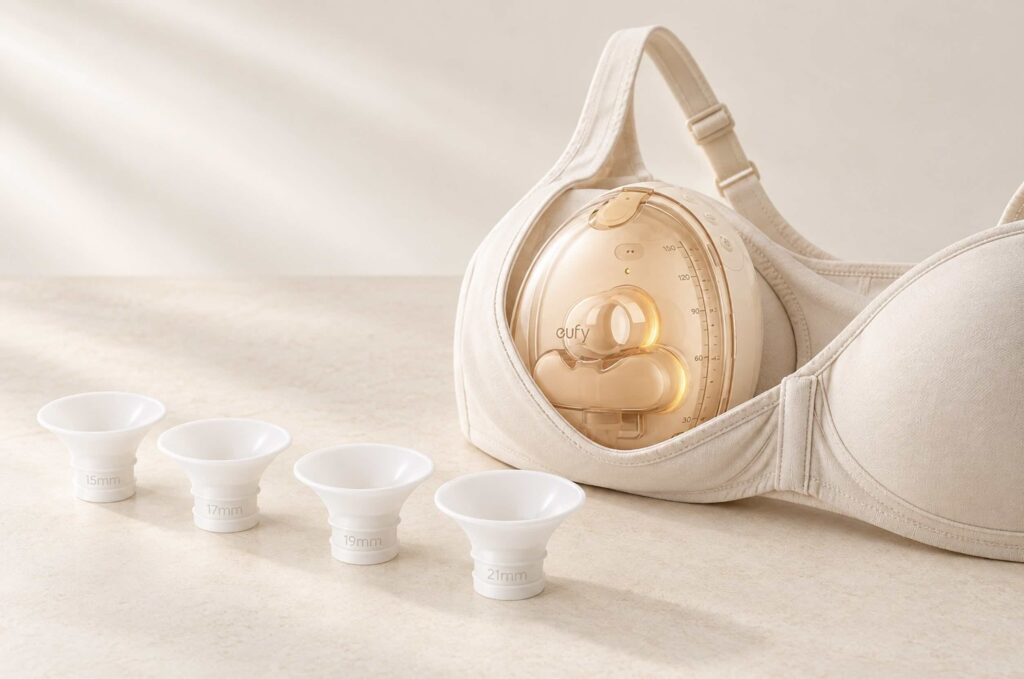
Alignment is easier to inspect when the tunnel is visible. Our eufy Wearable Breast Pump S2 Pro uses a 360-degree transparent design and a built-in nipple light. The standard flange is 24 mm. Included sizing inserts cover 15, 17, 19, and 21 mm, and a 27 mm flange kit is sold separately. Those numbers belong to flange selection. They do not tell anyone which bra will fit.
The movement check brings other S2 Pro features into view. Its double-sealed silicone flange is intended to maintain contact as the wearer moves or bends. Sensors warn of a leak risk while bending and stop the pump when the milk container is full. The warning tells you what’s happening in the moment, but it can’t fix a loose fit. Start with the cup sitting evenly.
When a Dedicated Pumping Bra Still Helps
When does a dedicated bra earn space in the drawer? Usually, when the same problem keeps returning. In some homes, that problem is not the wearable cup at all but the need to switch between pump formats.
One bra with cup support and flange openings may suit that mixed routine. It still has two jobs to pass. An external flange can sit securely while the wearable cup feels crowded in the same garment.
For someone else, the problem appears only away from home. The cup stays put on the couch but shifts during a workday or while seated in a parked car. A different size or fabric may solve it. Keeping one pumping-only bra is another practical answer, especially when a familiar fit saves repeated adjustments.
A nursing-and-pumping design may cut down on clothing changes. Extra construction is not automatically an advantage, though. A panel that supports one cup shape can put a seam against another, which sends the decision back to the same fit checks.
Conclusion
For many wearable pump users, a pumping bra remains optional. The evidence is ordinary: a level band, enough cup depth, and a pump that stays put during permitted movement. Without those basics, a special flange opening changes very little.
Try the bra already on hand with the actual pump. A dedicated style may still make sense when two pump formats share the week, ordinary bras keep allowing movement, or one garment needs to handle nursing and pumping. Pain, pronounced marks, skin damage, or uncertainty about flange size are not shopping problems. Ask an IBCLC or doctor.