
Selank is a synthetic heptamino-acid chain used in peptide research. Before ordering, you’ll want proof it’s the right compound: clear specs, a COA confirming purity for the exact batch, and records you can file.
A 2026 review of independent lab reports found about 1 in 40 research peptide samples did not show the peptide on the label. So, when we pick a vendor, we make sure the compound’s identity, purity, and other assays are backed by the latest, lot-matched, independent report.
That’s where Kylo stands apart from other vendors. You can buy Selank peptide from Kylo Peptides as a 10 mg vial of lyophilized powder for $49.95, with a published, lot-matched COA showing 99.3% purity, and identity confirmed by mass spec. Kylo members get 50% off every vial for life, bringing the final price to $24.98, or about $2.50 per mg.
Selank Explained: Chemical Identity and Molecular Characteristics
What Is Selank?
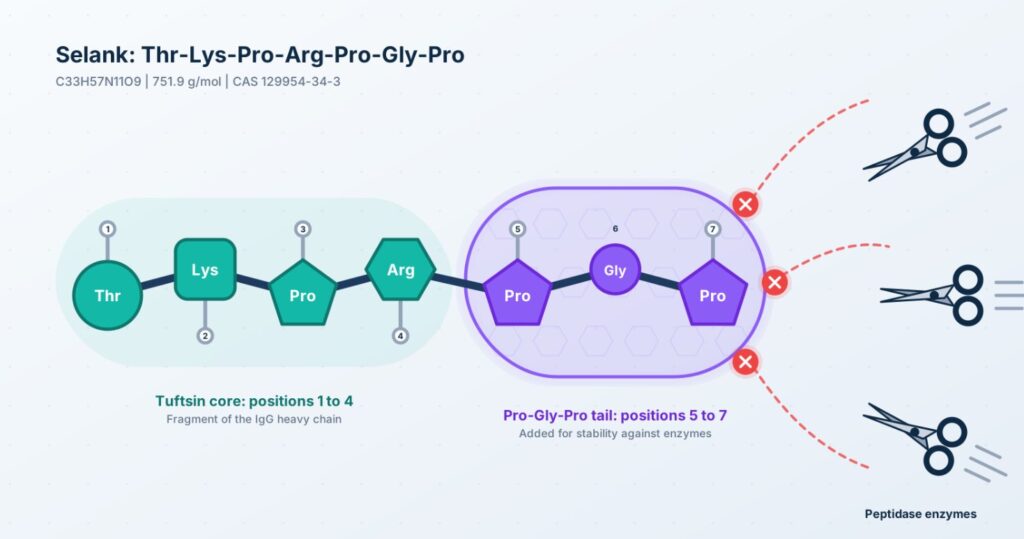
Selank is a synthetic heptapeptide with the sequence Thr-Lys-Pro-Arg-Pro-Gly-Pro. Its first four amino acids are tuftsin, a small fragment of the immunoglobulin G heavy chain. Researchers at the Institute of Molecular Genetics of the Russian Academy of Sciences added Pro-Gly-Pro to the end for stability.
Selank’s Chemical Specifications
Kylo’s listing specifies the Selank formula as C33H57N11O9, a molecular weight of 751.87 g/mol, and the CAS number 129954-34-3. The details agree with Selank’s PubChem record (CID 11765600).

Selank Versus Similarly Named Peptides
Buyers often confuse Selank with a few other research compounds. Semax is the most common example, but it is a different peptide made from an ACTH(4-10) fragment. Similarly, N-acetyl Selank and amidated Selank are different compounds, each with distinct molecular masses. Check the full product name before lining up prices.
What to Look for in a Selank Product Listing
Labeled Quantity and Physical Form
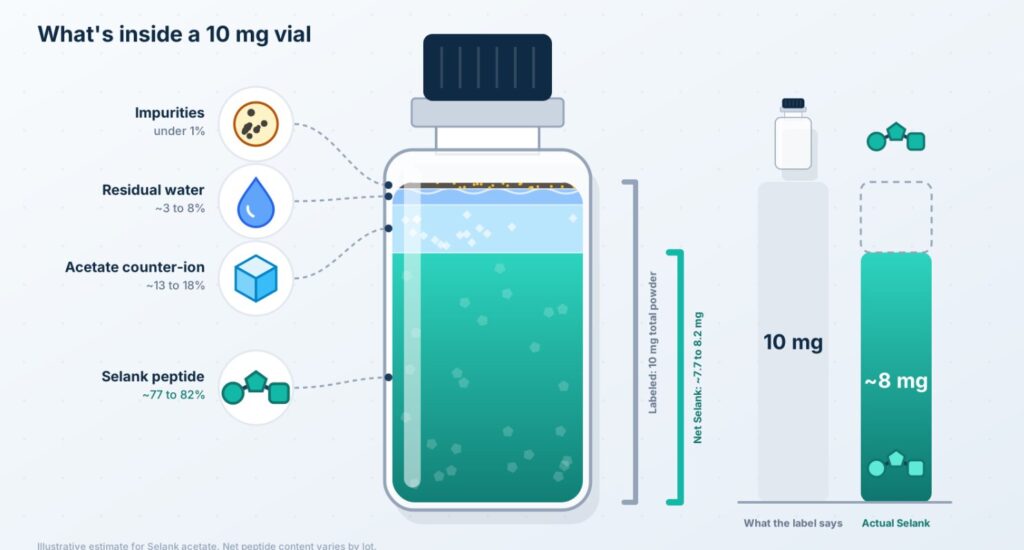
Most research Selank comes as lyophilized (freeze-dried) powder in 5 mg or 10 mg vials. Nevertheless, before ordering, check the size and the format. For example, a 10 mg vial contains 10 mg of total material. Purity and net content checks show how much, or what share, of it is the peptide.
Product Identity and Lot Information
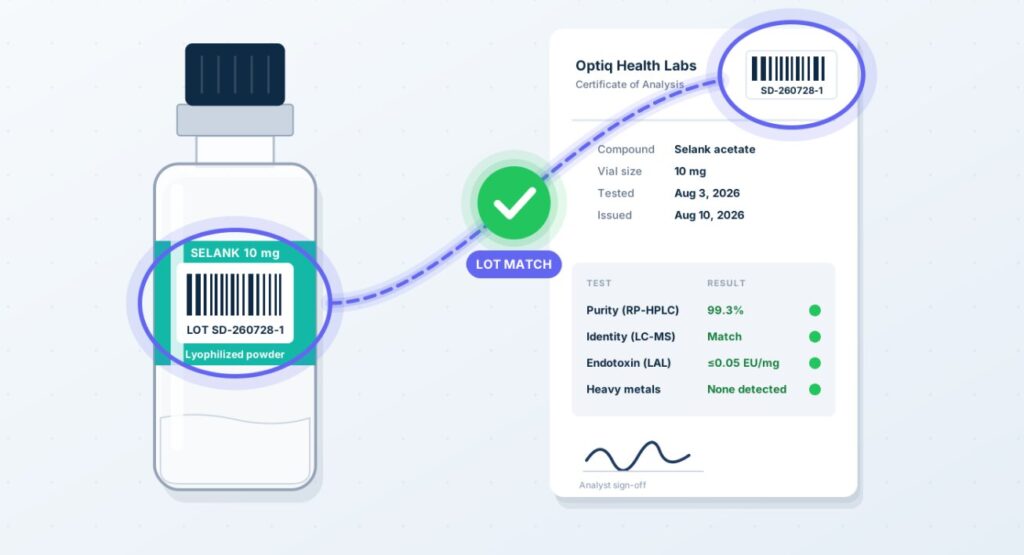
Look for a lot or batch number with a COA attached to it. The lot number links a lab report to a physical batch. For Kylo’s current Selank, that’s SD-260728-1, and your vial should carry the same code.
Information That Should Not Be Assumed
When a listing skips the lot number, quotes purity without a lab, or offers the COA “on request,” you need to email support to sort things out. Ask which lot will ship, who tested it, and on what date. If possible, request that they share a COA report for your batch.
Buy Selank Peptides From Kylo Peptides: Product and Documentation Review
We went through Kylo’s Selank listing and its COA library.
Selank Product Availability and Specifications
| Spec | What The Listing Shows |
| Product | Selank 10 mg (single size) |
| Form | Lyophilized powder, acetate counter-ion |
| Price | $49.95 (member price $24.98) |
| Stock | In stock, 48 vials listed |
| Storage | −20 °C as powder; 2 to 8 °C short term once reconstituted |
| Identity | LC-MS against 751.87 g/mol |
The Selank 10 mg listing at Kylo offers one size, which rules out a variant mix-up at checkout. It also carries a storage warning about avoiding repeated freeze-thaw cycles.
Reviewing Kylo’s Analytical Documentation
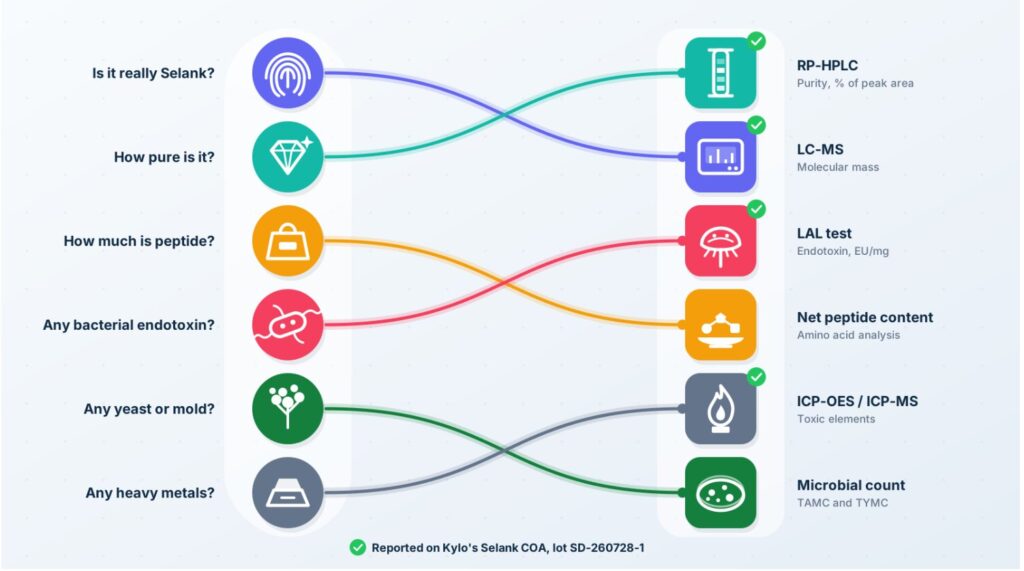
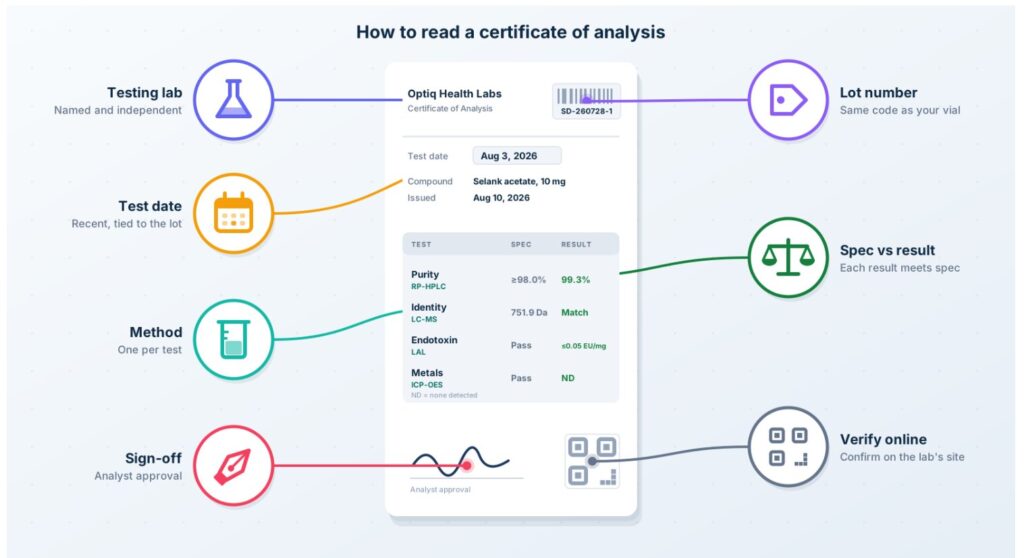
The COA library lists one Selank lot, SD-260728-1. It was tested by Optiq Health Labs on August 3, 2026. The report was issued on August 10. It shows 99.3% purity by RP-HPLC against a ≥98.0% spec, identity confirmed by LC-MS, endotoxin passing at ≤0.05 EU/mg, and no detectable heavy metals. The library also links to Optiq’s own verification page, so you can confirm the result without going through Kylo.
What the Product Page Establishes, and What It Does Not
Together, the product page and COA library cover the compound, specs, price, storage, and lot results.
Selank Purity and Identity Testing: How to Interpret a COA
A COA is the lab report for one batch, and each test covers different grounds. In a 2026 preprint awaiting peer review, Christopher Mendias and Tariq Awan analyzed 6,285 independent lab reports on research peptides.
Depending on the standard applied, 41.6% to 71.1% of samples missed basic quality criteria. Selank wasn’t in their data, but the conclusion holds broadly: “the manufacturer is as important a determinant of quality as the compound itself.”
HPLC and Reported Purity
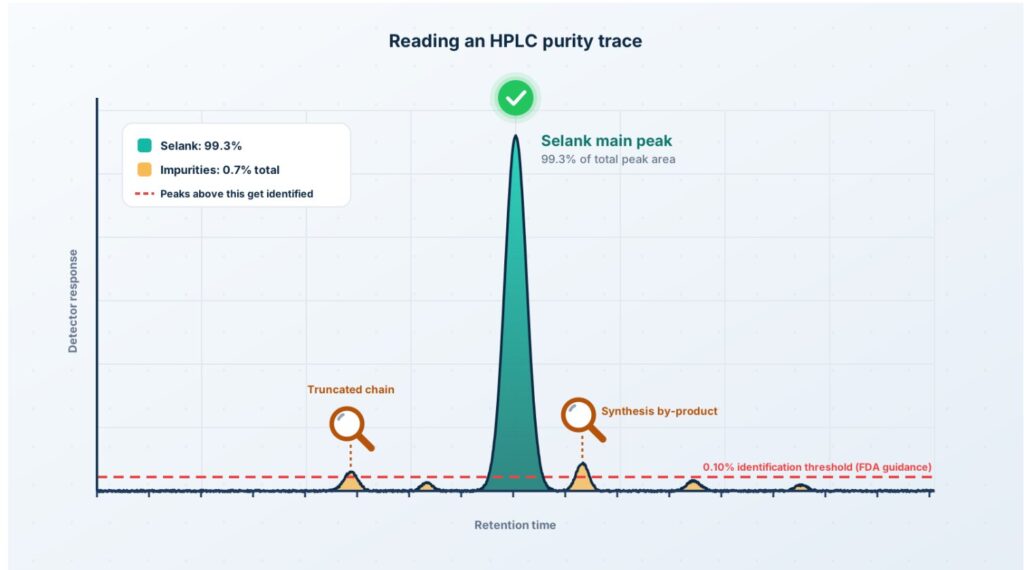
HPLC (high-performance liquid chromatography) splits a sample into its parts. The purity score reflects how much appears as a single main peak. Kylo’s 99.3% means the other 0.7% is broken-off chains and leftovers from making the peptide.
For context, FDA guidance on synthetic peptides asks drug makers to identify any impurity at 0.10% or more. FDA’s bulk drug substances page, updated April 22, 2026, also flags impurities and clumping (aggregation) as concerns for selank acetate.
LC-MS and Molecular Identity
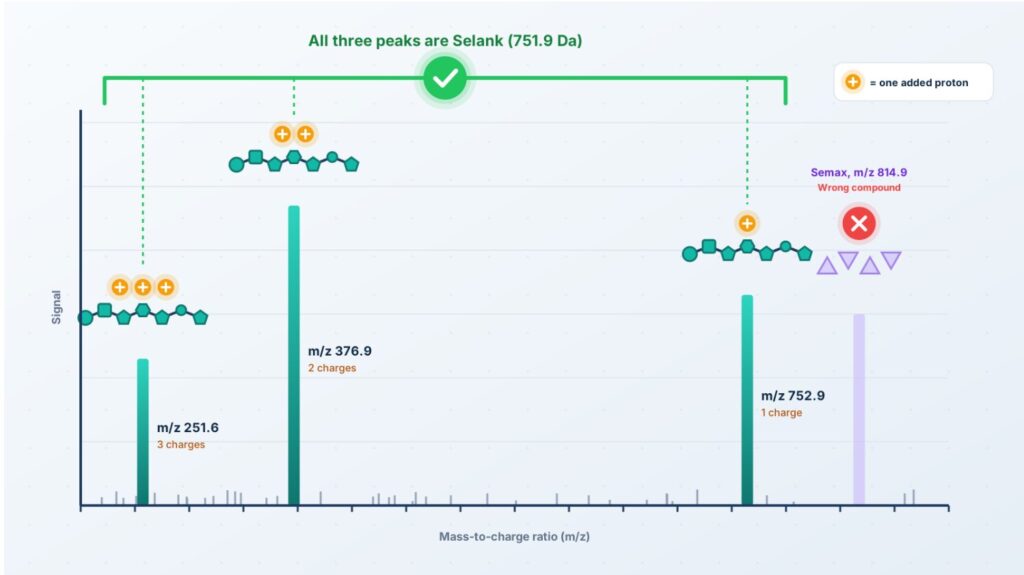
Liquid chromatography-mass spectrometry (LC-MS) measures the molecule’s mass, and Selank should appear around 751.9 Da. A very clean HPLC peak can still belong to the wrong peptide, and mass alone won’t show it.
Checking a Lot-Matched Certificate of Analysis
Check the compound name, lot number, method, lab, test date, and each result against its spec, then compare the lot number with your vial. An older sample COA shows the supplier tested its products, while a report with your lot number reflects your vial.
Other Tests and Their Scope
Endotoxin (LAL) testing looks for bacterial residues, microbial counts cover yeast and mold, and ICP-OES screens for heavy metals. Which ones matter depends on your research setup. Mendias and Awan found purity had no relationship with endotoxin (R² under 0.01), so read each claim against the actual report.
Selank Pricing: Understanding What the Listed Price Covers
Compare Price Against Labeled Quantity
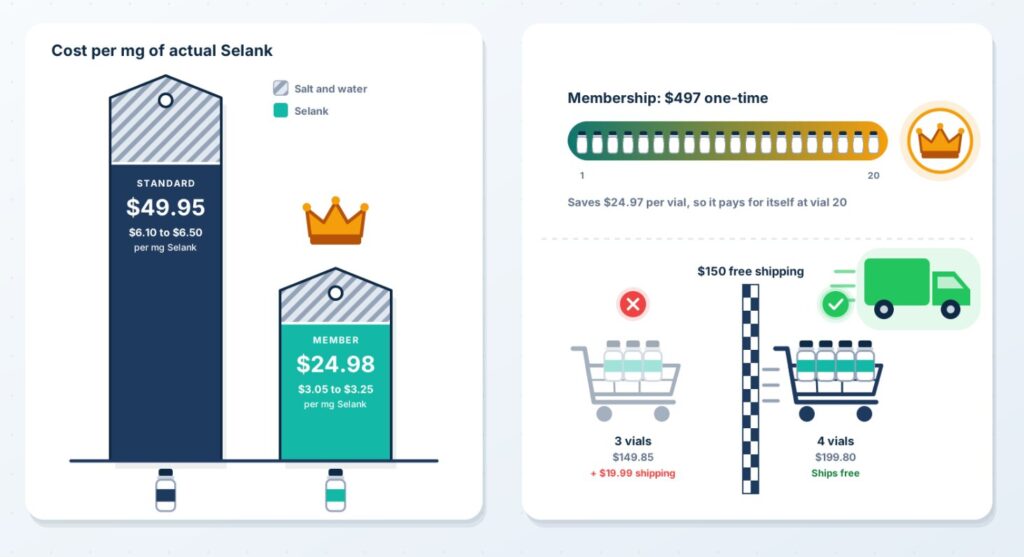
To compare fairly, divide the price by the labeled milligrams. Kylo’s $49.95 for 10 mg comes to $5.00/mg. Members pay half, $24.98 or about $2.50/mg, after a one-time $497 lifetime membership. Prices change, so check that the figure is current and whether it’s a promo.
Consider Documentation Alongside Price
A low price says nothing about analytical quality on its own. Weigh it against what comes with it: a named lab, a COA for the specific lot, and a test date. Kylo ships free on US orders over $150 and charges $19.99 below that.
Product Availability, Shipping, and Order Documentation
A few checks before and after ordering keep your records intact.
Confirm Current Availability
Make sure the item is listed and in stock, and that the size you pick matches the size on the COA. Kylo sells Selank in a single 10 mg vial, which keeps records simple.
Review Shipping and Order Terms
Kylo lists 24-hour dispatch on business days from a US warehouse, with tracked delivery in roughly 2 to 4 business days. It ships within the US only, and a cold pack costs an extra $9.99. Orders are covered by a 30-day money-back guarantee.
Maintain Research Traceability
File the order confirmation, a copy of the product details, the lot ID on the vial, and the matching COA together. If a result ever looks odd, you’ll know which batch to ask about.
Selank vs. Semax: Key Differences for Compound Identification
Selank and Semax often sit side by side in catalogs, yet they’re different molecules.
Different Peptide Identities
Both are synthetic seven-residue peptides ending in Pro-Gly-Pro. Selank is built on tuftsin and Semax on an ACTH(4-10) fragment, as peptide researcher Kathy Lucas explains in her Semax vs Selank breakdown. Different sequences give different formulas and masses, so one can’t stand in for the other.
| Compound | Sequence note | Expected mass |
| Selank | Thr-Lys-Pro-Arg-Pro-Gly-Pro | 751.9 Da |
| N-acetyl Selank | Selank + acetyl group | about 793.9 Da |
| N-acetyl Selank amidate | Acetylated and amidated | about 792.9 Da |
| Semax | Met-Glu-His-Phe-Pro-Gly-Pro | 813.9 Da |
| Tuftsin | Thr-Lys-Pro-Arg | 500.6 Da |
Why the Distinction Matters When Reviewing Supplier Catalogs
Mass is the quickest way to tell them apart on a COA. Selank should read about 751.9 Da, Semax about 813.9 Da, and a blend should show both. Tuftsin makes up Selank’s first four residues, so a truncated chain can also turn up near 500.6 Da. Checking the name, formula, and mass together catches each case.
Common Mistakes When Evaluating Selank Listings
- Treating high purity as proof of quality: Pair the HPLC result with LC-MS identity.
- Taking a company-wide testing policy as a Selank result: Find the report for the Selank lot you’re buying.
- Ignoring the lot number: Make sure the COA lot matches the vial.
- Confusing labeled quantity with purity: “10 mg,” “99%,” and net peptide content are three separate figures. Lyophilized peptides hold water and counter-ions. Hello Bio’s technical notes put peptide content at roughly 70 to 90% of powder weight. By our calculation, Selank as an acetate salt tops out around 81 to 86% before water.
- Comparing prices without specs: Work out price per mg, then look at the documentation behind it.
- Treating Selank, Semax, and blends as interchangeable: Confirm the name and the expected mass.
Final Selank Supplier Verification Checklist
We call this the lot-match check, and it takes a few minutes per listing.
- Confirm the compound and exact variant.
- Check the labeled quantity and form.
- Find the lot-matched COA.
- Review the LC-MS and HPLC methods.
- Verify the lab, test date, and results.
- Compare price per mg and shipping.
- File the order, lot ID, and COA together.
Kylo’s Selank 10 mg meets every point, with a named lab, a dated report, and a matching lot number. Verifiable details provide a sounder basis for choosing a supplier than marketing claims.
Frequently Asked Questions
What is Selank chemically?
Selank is a synthetic heptapeptide, Thr-Lys-Pro-Arg-Pro-Gly-Pro, with formula C33H57N11O9, a molecular weight of about 751.9 g/mol, and CAS 129954-34-3.
What should a Selank COA contain?
It should list the compound, lot number, lab, test date, and methods, with HPLC purity and LC-MS identity reported against a spec for your vial’s lot.
Does a high purity percentage confirm Selank identity?
No. Purity shows how clean the main HPLC peak is. Identity comes from LC-MS, which confirms the molecule weighs about 751.9 Da.
How is Selank different from Semax?
Selank is built on tuftsin and Semax on an ACTH(4-10) fragment. Both have seven residues and a Pro-Gly-Pro tail, but their masses differ: about 751.9 Da versus 813.9 Da.
Why does a lot-matched COA matter?
Each batch is made and tested separately. A lot-matched COA ties the lab’s results to the exact batch in your vial.
What should researchers check before evaluating a Selank supplier?
Check identity, labeled quantity and form, a lot-matched COA with HPLC and LC-MS results, the lab and date, price per mg, and shipping.
Medical Disclaimer: The Site does not provide medical or health advice. Any health-related information is provided for general educational purposes only and should not be interpreted as medical advice, diagnosis, treatment, or a substitute for professional medical care. Before taking any action based on health information found on the Site, consult a qualified medical professional. Use of the Site does not create a doctor-patient relationship. You agree not to rely on any health information on the Site as a substitute for professional medical advice. Selank is sold for in vitro research only and is not FDA-approved for human use. Quality varies by supplier and batch, so verify independently.


